

Overview
In sprints and horizontal jumps the wind is part of the result, which makes two marks set on different days hard to compare honestly. A 10.95 with +1.9 m/s and a 10.95 into a headwind are not the same race, and the ranking that puts them side by side quietly pretends they are.
Wind Correction estimates what a performance would have been under any other wind. Athletes use it to normalise their own marks, coaches to compare across meetings, and anyone curious to ask what a race would have looked like on a still day.
What I built
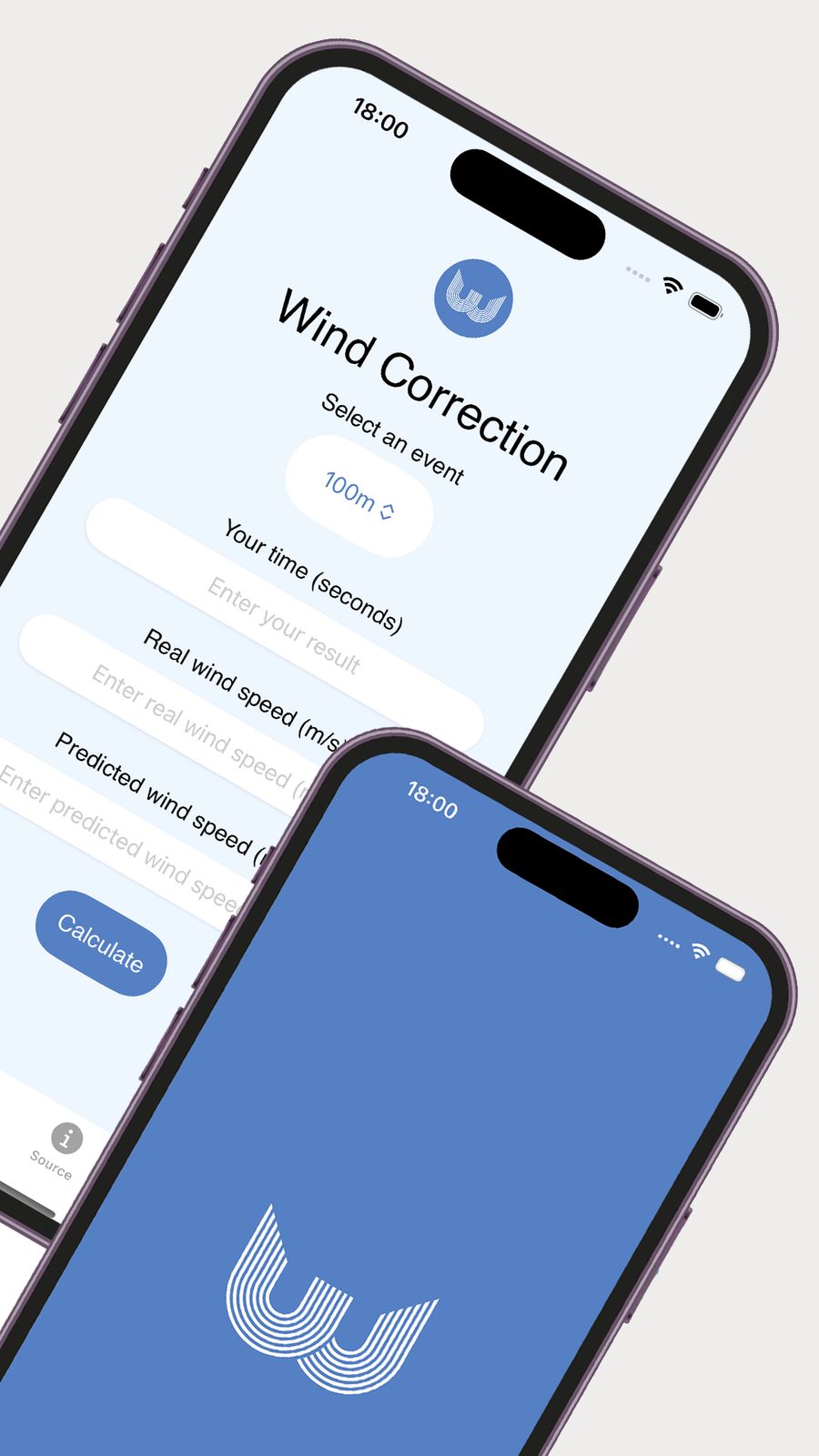
- Pick an event: 100 m, 200 m, 100/110 m hurdles, long jump or triple jump.
- Enter the mark and the wind it was set in.
- Choose the wind to compare against — neutral by default, or any scenario within ±6 m/s.
- Get the corrected time or distance instantly, with event-specific coefficients.
- Built natively in SwiftUI, so it runs offline on the phone that is already in the coach's pocket.
The correction is data-driven, not a rule of thumb: it follows Moinat, Fabius & Emanuel, “Data-driven quantification of the effect of wind on athletics performance” (European Journal of Sport Science, 2018), derived from large datasets of official results. The numbers are estimates — wind correction is inherently probabilistic, and it is most reliable inside realistic wind ranges.
In pictures


Try it here
Same formulas as the app
Put in a mark and the wind it was set in, then pick the wind you want to compare it against. Zero is the honest default: it's what every performance would be worth on a still day.
Enter a time to see it corrected.
Corrections are estimates: they model the aerodynamic effect of wind, not the race.